The Case of the Vanishing Schema Field
Published: December 27, 2025
This is the story of a bug that appeared and disappeared at random. It's about decompiled JARs, schema ownership, code generation, and the JVM classloader.
The Setup
Our microservices relied on Apache Avro for serializing data through Kafka. At the center of it all was a simple schema: MoneyAmount.avsc.
{
  "namespace": "com.etrandafir.blog.samples",
  "type": "record",
  "name": "MoneyAmount",
  "fields": [
    {"name": "amount", "type": "double"},
    {"name": "currency", "type": "string"}
  ]
}
When we looked into how to make the change, we discovered that Order.avsc and MoneyAmount.avsc lived in different repositories. The order-api library was pulling in MoneyAmount.avsc from its remote location to generate the Java classes during build time.
At some point, somebody had tried to build MoneyAmount as a separate JAR in a commons library. But that didn't work—libraries like order-api needed the MoneyAmount.avsc file itself during their build process to generate Java classes from schemas that referenced it. So that initiative got abandoned pretty quick, and we kept the setup as-is.
The Change
One day, a requirement came in: "We need the currency symbol (like $, €, £) in our Order events."
Simple enough. We added a new field to MoneyAmount.avsc:
{
  "namespace": "com.etrandafir.blog.samples",
  "type": "record",
  "name": "MoneyAmount",
  "fields": [
    {"name": "amount", "type": "double"},
    {"name": "currency", "type": "string"},
    {"name": "symbol", "type": "string", "default": ""}
  ]
}
We updated order-api, rebuilt it, ran the tests locally—everything passed. We pushed to the test environment. Still green.
We were ready for production.
Later That Week
Then, a different team integrated a completely unrelated feature. They re-deployed the application to the test environment.
Boom.
org.apache.avro.AvroRuntimeException: Unknown field: symbol
The application crashed during serialization. MoneyAmount objects suddenly didn't have a symbol field anymore.
"It must be the new feature," someone said. We quickly checked —no, the new feature had nothing to do with orders. We rolled it back anyway. Restarted the service.
Everything worked again.
Wait, what?
Phantom Restarts and Forgotten Libs
We had a mystery on our hands. The behavior was completely non-deterministic:
- Tests were passing locally
- Tests were passing in CI/CD
- Sometimes the service worked fine after restart
- Sometimes it failed after restart
We pulled the order-api JAR from Artifactory and decompiled it. There it was—the MoneyAmount class with the symbol field, exactly as expected. "The JAR is correct" - we thought. "So what's going on?"
Then someone asked: "Are there any other libraries use the _MoneyAmount schema?" We checked. The _payment-api library also had Avro schema generation configured. It pulled MoneyAmount.avsc and generated its own MoneyAmount java class.
"When was payment-api last built?" We checked the timestamps. One month ago. Before our schema change.
The pieces started falling into place.
The Smoking Gun
Both order-api and payment-api were generating their own MoneyAmount classes from the same Avro schema. Since both versions of the schema had the same namespace, both generated classes had the same fully qualified name.
At runtime, the JVM encountered two different versions of the same class on the classpath. Here's the issue, reproduced in a simplified setup. Which version gets loaded? Will this main() method work or fail?
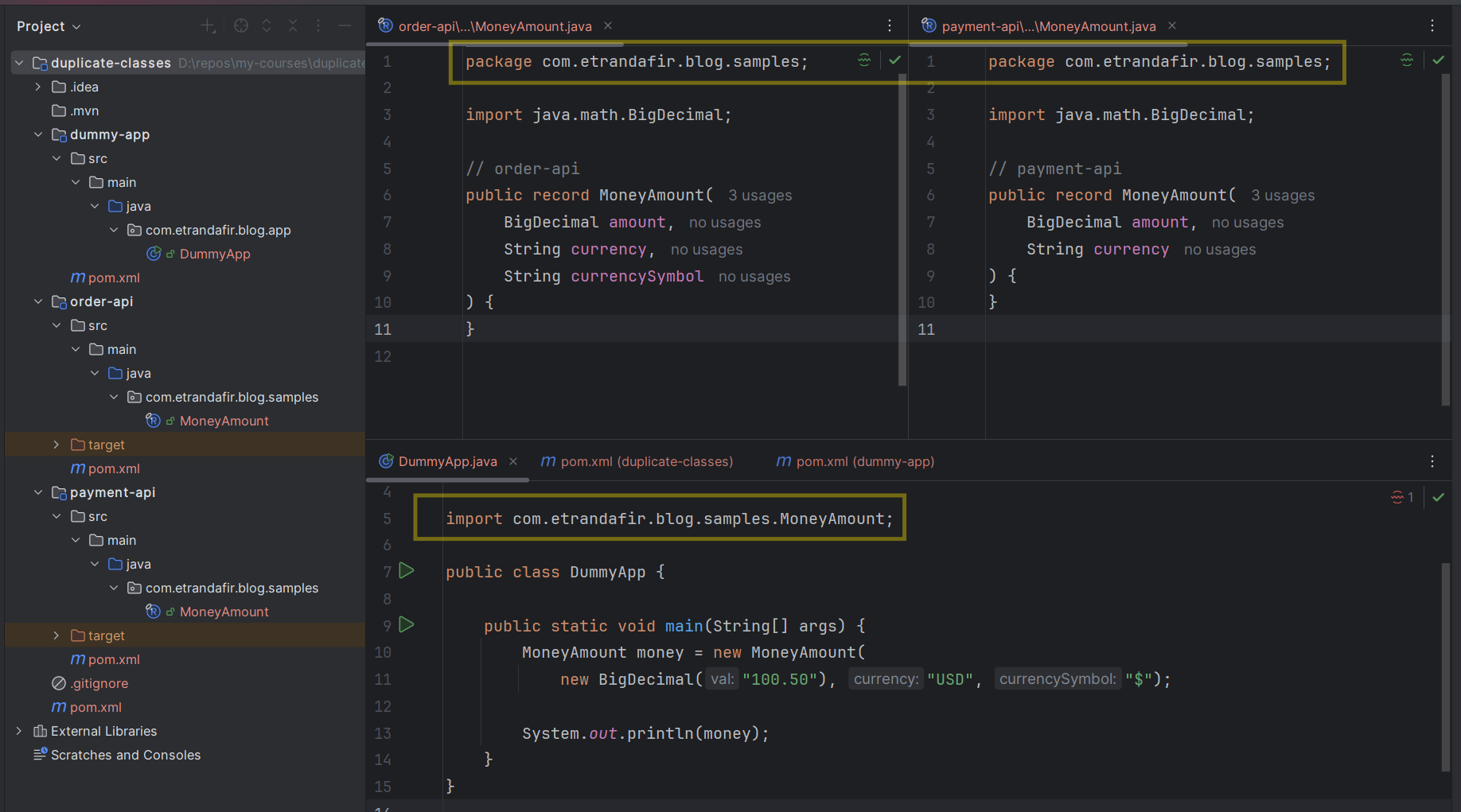
Turns out the JVM will silently pick one and discard the other - not even a warning. It all depends on the classpath order.
For instance, we can force loading the order-api.jar first by running the application this way:
java -cp ^
  "order-api/target/order-api-1.0-SNAPSHOT.jar;^
  payment-api/target/payment-api-1.0-SNAPSHOT.jar;^
  dummy-app/target/dummy-app-1.0-SNAPSHOT.jar" ^
  com.etrandafir.blog.app.DummyApp
This will result in the happy path we were usually seeing, in our example, the toString() of the MoneyAmount object:
MoneyAmount[amount=100.50, currency=USD, currencySymbol=$]
On the other hand, we can reverse the order of the JARs, the main() method will fail to create a MoneyAmount instance. It'll say it's not aware of a MoneyAmount constructor accepting three parameters (amount, currency, symbol), it only knows the old two-parameter constructor:
Exception in thread "main" java.lang.NoSuchMethodError:
    'void com.etrandafir.blog.samples.MoneyAmount.<init>(java.math.BigDecimal, java.lang.String, java.lang.String)'
        at com.etrandafir.blog.app.DummyApp.main(DummyApp.java:10)
The JAR ordering was effectively random during service startup, which explained the non-deterministic behavior.
What Went Wrong
We had violated a fundamental principle: a generated class should have exactly one owner. Our setup allowed multiple libraries to independently generate the same class from the same schema. When the schema evolved, each library built its own version at different times, creating conflicting definitions on the classpath. The JVM's classloader picked one version at random, making the behavior completely non-deterministic.
But there's a deeper issue here. In Domain-Driven Design terms, payment-api and order-api represent different bounded contexts. Each context should own its data models. If both contexts needed a money concept, each should have declared its own MoneyAmount schema —even if they looked similar. Instead, we had a shared schema with no clear ownership, living in a separate repository that neither context truly controlled.
How We Could Have Caught It Earlier
The service in our test environment was rarely restarted, but our CI/CD pipeline ran tests constantly. If we had integration tests that actually went through the Kafka layer, we would have caught this much earlier.
Using tools like Testcontainers or Embedded Kafka would have surfaced the issue. Sure, this test might have produced some false negatives, but it would have been failing often enough for us to investigate.
Another tool that could have saved us is the Maven Enforcer Plugin with its banDuplicateClasses rule. This plugin scans your dependencies at build time and fails the build if it detects multiple JARs providing the same class. If we had configured it in our projects, the build would have failed immediately, preventing the duplicate MoneyAmount classes from ever reaching our test environment.
Let's add the Maven Enforcer Plugin to our sample project's pom.xml:
<build>
  <plugins>
    <plugin>
      <groupId>org.apache.maven.plugins</groupId>
      <artifactId>maven-enforcer-plugin</artifactId>
      <version>3.6.2</version>
      <executions>
        <execution>
          <id>enforce-ban-duplicate-classes</id>
          <goals>
            <goal>enforce</goal>
          </goals>
          <configuration>
            <rules>
              <banDuplicateClasses>
                <findAllDuplicates>true</findAllDuplicates>
                <ignoreWhenIdentical>true</ignoreWhenIdentical>
              </banDuplicateClasses>
            </rules>
            <fail>true</fail>
          </configuration>
        </execution>
      </executions>
      <dependencies>
        <dependency>
          <groupId>org.codehaus.mojo</groupId>
          <artifactId>extra-enforcer-rules</artifactId>
          <version>1.11.0</version>
        </dependency>
      </dependencies>
    </plugin>
  </plugins>
</build>
After configuring this plugin, any attempt to build a project with duplicate classes would fail immediately. Let's try it out in our sample project:
[INFO] ------------------------------------------------------------------------
[INFO] Reactor Summary for duplicate-classes 1.0-SNAPSHOT:
[INFO]
[INFO] duplicate-classes .................................. SUCCESS [  0.186 s]
[INFO] payment-api ........................................ SUCCESS [  0.853 s]
[INFO] order-api .......................................... SUCCESS [  0.083 s]
[INFO] dummy-app .......................................... FAILURE [  2.575 s]
[INFO] ------------------------------------------------------------------------
[INFO] BUILD FAILURE
[INFO] ------------------------------------------------------------------------
[INFO] Total time:  3.778 s
[INFO] Finished at: 2025-12-28T17:19:12+02:00
[INFO] ------------------------------------------------------------------------
[ERROR] Failed to execute goal org.apache.maven.plugins:maven-enforcer-plugin:3.6.2:enforce (enforce-ban-duplicate-classes) on project dummy-app:
[ERROR] Rule 0: org.codehaus.mojo.extraenforcer.dependencies.BanDuplicateClasses failed with message:
[ERROR] Duplicate classes found:
[ERROR]
[ERROR]   Found in:
[ERROR]     com.etrandafir.blog:payment-api:jar:1.0-SNAPSHOT:compile
[ERROR]     com.etrandafir.blog:order-api:jar:1.0-SNAPSHOT:compile
[ERROR]   Duplicate classes:
[ERROR]     com/etrandafir/blog/samples/MoneyAmount.class
Lessons Learned
- Generated code should have exactly one owner
- Avoid committing generated files—generate during build
- Allow each bounded context to define its own models, even if they look similar
- Unit tests aren't enough
This bug taught us that architectural mistakes don't always fail immediately. They lie dormant, waiting for the perfect storm: a schema change, a deployment, a classloader race condition.
You can play with a demo project and try the Maven plugin yourself at github.com/etrandafir93/dupped_java_classes.